Wednesday, October 2, 2013

Five Time Management Tips for School Leaders

Time Management Strategies

"Basic Idea: Most of our work isn’t actually based on time – it’s based on the projects and tasks that need to be done."

-Charlie Gilkey, on his blog

I read the statement above on Charlie's blog, Productive Flourishing, and thought, "Bingo!" It's exactly how I think about time. As a high school administrator, there are a lot of tasks that have to be done during a week. In this post, I hope to share some of my tips on how I get things done in my business and personal life.

1. Everything goes in a digital calendar. What are some things I put on my calendar? My daughters' athletic schedules, including practices. I put all meetings with teachers, parents, and other staff, even the "Hey, let's chat this week about that idea you had" meetings. For example, I schedule time to visit classrooms in the building. This is a priority, so if a parent or teacher wants a meeting, I schedule around visiting classrooms.
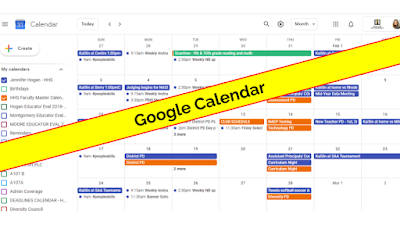


2. Touch a piece of paper only once. This is one of the toughest, both with real paper and virtual paper (email). I try to take action on a piece of paper when it crosses my desk (or computer) to prevent a backlog of items needing action. Once I deal with it, I toss it. 

3. Keep a short, High-Priority (HP) To-Do list in visible sight. I keep a sticky-note with a few HP items on my desk each day. These are things that must be done by the end of the day, and I keep them on my desk so that they are a constant reminder to follow-up, act, or complete. At the end of the day, I should be able to toss out the sticky-note.

4. Do your chores first. This time-management technique I learned from my mom. Growing up, I learned to do my chores first, then I could play or do whatever I wanted. Now, I use this principle in my work. I do the stuff I don't want to do first, then I get to do the things I really like to do that may not be productive.


5. Keep the main thing the main thing. It's easy to do things at work that aren't all that important but are easy to do so that something can get crossed off the long daily to-do list. Keeping the vision and mission as the driving force for what gets done each day ensures that what's most important gets done. 

Are there days when something gets overlooked? Are there days when everything doesn't get done? Absolutely. But using the five strategies above help me keep those days to a minimum. 

Do you use any of these time-management strategies? Which one is your favorite?


Tuesday, October 1, 2013

"Understanding the Moment" - Lessons from Baseball for Leaders

My husband and I were college athletes, and we believe in the lessons and experiences that come from athletics. We love stories of underdogs coming out victorious, stories of sacrifice and success, and stories of athletes overcoming odds. He shared with me the story that follows, and if you are a baseball fan you probably heard about it or you might have even watched it unfold. It's a story about "Understanding the Moment."

Mariano Rivera is a pitcher with one of the most storied professional baseball programs ever, the New York Yankees. Last week, the pitcher with the most career saves at 652, pitched his final game at Yankee Stadium.  Joe Girardi, who used to catch Rivera, is the manager for the NY Yankees. Joe Giarardi gets it. He understood the magnitude of the moment for Rivera last week. 

Girardi called for Rivera to come in the game in the eighth, and almost everyone in the stadium rose to their feet to cheer for baseball's all-time saves leader. After retiring 4 batters, Garardi called for a closer to come in for Rivera. But Girardi didn't go out to the mound, he sent out Andy Pettitte and Derek Jeter, two of Rivera's long-time teammates. 

 
  Watch the video clip here of Rivera's last game.

Joe Girardi could have ignored the moment. He could have made an excuse. He could have let it slip by. Instead he made the most of it for Rivera. He understood what pitching your last game at Yankee Stadium in your final season of professional baseball meant. And he made the most of it for Rivera. 


As school leaders, what do we do to make moments special? Are we thoughtful and intentional in our celebrations of students and staff? 

Do we understand the moment?


Sunday, September 22, 2013

Collaboration in a High School English Language Arts Class

The best part of my day each day is visiting classrooms. Some days I have "no office" days where I spend a lot of time in and out of classrooms, and some days it may be only during one class period where I get to spend time in classrooms. Spending time observing teaching and learning is second only to when I get to call a parent and brag on their child getting "written up" with a Praise Referral

Friday, one of our new teachers invited me to drop by and see what her students were doing in class that day. While I usually tweet the great things that are going on in our classrooms, I knew I wanted to devote a blog post and share about her lesson that she had designed for that particular day.


This is Mrs. Mann, who teaches ELA to 9th graders

Mrs. Mann told me that the students would be taking a quiz then they would start their activity. I visited another classroom, then went to her classroom. When I arrived, the students were already in the middle of their assignments. 

On the screen at the front of the room, Ms. Mann posted these instructions.


The students were engaged in discussion about The Most Dangerous Game by Richard Connell. Mrs. Mann was walking around the room giving encouragement and periodically letting the students know how much time had passed.


Each group had to organize parts of the story onto this large poster.

The students had been divided into groups, and they each received a diagram on a large poster (above). They also received a baggie that contained strips of paper, each with an excerpt from the story.


For the first part of the challenge, the students had to decide the correct order in which to place the strips onto the large poster. 


Once they completed that part of the challenge, they then had to meet as a group with Mrs. Mann for a Q&A session. Once the group finished the Q&A session, she would check their poster. If the strips were out of order, she would tell them to go back to the drawing board and try again. She would then start with the next group that had finished with their strips and they would move to the Q&A session. 

Mrs. Mann made it a competition to tie in with The Most Dangerous Game, and she had candy for the winners. (It's amazing what high school kids will do for a small piece of candy!)


Mrs. Mann is a new teacher this year, and I'm so proud of the learning that is going on in her room. She constantly asks herself, "What can I do to make this lesson one that will capture my students' attention and help them to learn best?"

While she could have led a whole-class discussion or had students answer questions on a worksheet, she chose to find a way that would be concrete, tactile, collaborative, and challenging.  

What is your favorite part of this lesson?


Wednesday, September 18, 2013

What does Solution-Focused Therapy have to do with Innovation?

First...... what IS Solution-Focused Therapy? It's a type of psychotherapy that focuses on the solution rather than the problems.

When first learned of this term, I think I was in graduate school. It didn't seem like anything new... it seemed like what I had done in athletics as a player and a coach. We didn't focus on the problem, but we focused on the solution. We learned that focusing on the problem keeps you status quo, but never moving forward. Focusing on the solution helped us to continually remember that we can't change what's already happened, but we can change the future. 

This makes me think of innovation. When trying to innovate, the focus has to be on the future. We can't substitute for the past, but we need to try to create a new and different future. 

How does innovation happen in schools? There are three requirements:

  • The school culture supports teachers taking risks and even possibly failing.
  • The school culture focuses on doing Whatever It Takes to help students learn
  • The staff, collectively and individually, focuses on creating a NEW future for the students we serve.
It also reminds me of the students that I serve as the ninth grade principal. I have several students who are repeating the ninth grade, and the habits they had last year that helped them to repeat ninth grade are re-surfacing as we start this new school year. Which leads me to ask myself and others around me who work with these students... 

How are we going to innovate so that these students don't have the same year they had last year?