Thursday, May 11, 2023

How to find your Core Values


Our core values are the guiding principles that shape our beliefs, decisions, and actions. They are the deeply held beliefs that drive our behavior, influence our attitudes, and define who we are. 

Identifying our core values is an essential step in building a fulfilling life, a successful and rewarding career, and healthy relationships. 

But how do we find our core values?

In this post, I'll share some strategies to help you identify your core values.


How to find your Core Values

Self-reflection

Self-reflection is a powerful tool to identify your core values. Take some time to reflect on your life experiences, your achievements, your failures, your relationships, and your goals. 

At a recent session of the Hope Leadership Academy led by Dr. Amy Johnston, she shared the following questions to help participants identify their own core values: 
1. When you were a child, what virtue did your parents most want to instill in you?
2. If you saw a "For Sale" sign in your neighbor's yard, what virtue do you hope the new neighbors have?
3. What virtues do you want to see in your co-workers?
4. What values do you hope to instill in your students?
5. At your funeral, what virtue do you hope is used to describe you in your eulogy? 

Look at your role models

Our role models can provide valuable insights into our core values. Think of the people you admire and respect. What qualities do they possess that you admire? What values do they represent? Look for commonalities between your role models and what they stand for. It can help you identify values that resonate with you.

Identify what triggers you emotionally

Our emotions can be powerful indicators of our core values. Think of the situations or events that evoke a strong emotional response from you. What is it about those situations that trigger your emotions? It could be a sense of injustice, fairness, or compassion. Whatever it is, it can give you clues about your values.

Assess your priorities

Our priorities reflect our values. Take a look at how you spend your time, energy, and resources. What do you prioritize in your life? Is it your family, career, hobbies, or social life? How do you balance these priorities? By analyzing your priorities, you can identify your values and what matters most to you. 

Where to look first? Your bank account and your calendar. The things that we make a priority will show up clearly in those two places.

| Related Post: Staying Balanced in Life

Take a values and/or strengths assessment

There are many values and strengths assessments available online that can help you identify your core values. These assessments usually involve answering a series of questions that measure your preferences and priorities. The results can help you identify your top values and how they influence your behavior. One popular (FREE!) values assessment is the VIA Inventory of Strengths


Seek feedback from others

Sometimes, it can be helpful to seek feedback from others to identify your core values. Ask your friends, family, or colleagues to describe your strengths and weaknesses. What values do they see in you? How do they perceive your behavior? Their feedback can provide valuable insights into your values and how your values are perceived by others.

Final Thought

Should you live for your resume or your eulogy?


Identifying your core values is a process of self-discovery that requires self-reflection, introspection, and feedback from others. Your core values are unique to you, and they can change over time as you grow and evolve. By identifying your values, you can align your actions with your beliefs, make better decisions, and live a more fulfilling life. 


Pin now, Share later >>


Thursday, May 4, 2023

5 Reasons to Use Propello to Personalize Learning

Personalize Learning with Propello

My life’s mission has always been to empower others in their journey to becoming the best version of themselves, whether I was a teammate, coach, personal trainer, science teacher, high school administrator, or character coach. 

One of the key reasons I started The Compelled Educator long ago was to create a space where I could share resources, ideas, and successful practices with others. 

When I was a science teacher, my ultimate goal was to inspire creativity and curiosity in my students. I wanted them to walk away with a love for science! 

I used inquiry-based lessons as much as possible, because I knew that there would also be times when direct instruction would be necessary to help students “connect the dots” when it came to clarifying myths about science and explaining scientific concepts. 

I was always looking for lessons that were inquiry-based, aligned with standards, and taught my students to ask questions and investigate problems. Before the Internet came along, it was difficult to find resources to add to my teacher toolbox. This is one reason I’m thrilled to share Propello with you today! 

https://propello.com/thecompellededucator

This post is sponsored by Propello. All opinions are my own.

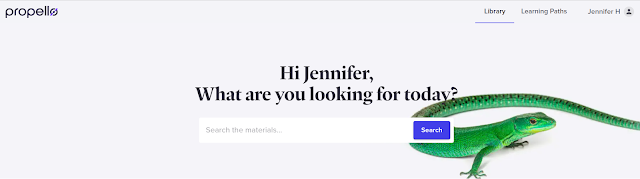
I discovered Propello at the 2023 ASCD Conference in Colorado. Propello is a FREE high-quality learning platform created by teachers, for teachers, and it’s evident when you visit the site that this platform is bold, innovative, and thoughtful in how it was created with the user in mind.

Personalize learning with Propello

Mission and Values

Propello has the potential to take a traditional classroom to a learning hub, and I believe it’s because of their mission and values that drive their work. 

From the Propello website: 

Learning for Everyone

We believe education is a right, not a privilege. By designing individualized learning solutions for every student, we are striving towards a more equitable future of education.

Spark Joy

Our goal is to create delight in every discovery. Designed to cultivate curiosity and inspire a lifelong love of learning in educators and students alike, our immersive curriculum helps knowledge take flight.

Challenge Convention

We're not afraid to break the mold. We see difficult conversations as opportunities to explore our potential, pushing us to create solutions that propel education upward.

https://propello.com/thecompellededucator


Here are 5 reasons to use Propello: 

1. Quality

The curriculum is aligned to Next Generation Science Standards (NGSS). The NGSS were created by states to improve science education for all K-12 students. Each state has its own unique standards, and Propello has reviewed the standards in each state to determine how the platform meets or supplements each state. Access to quality online learning helps every learner, no matter their zip code, to reach their full potential.


Personalize learning with Propello

2. Doing Science

Students can’t just learn ABOUT science, they need to DO science. Each of Propello’s units contain hands-on activities for students to learn concepts by investigating, reporting, and analyzing. Materials lists, instructions, and Teacher Tips are included for each activity to assist the teacher in managing the activities. (The Teacher Tips are great for brand new teachers! Did you just hire new science teachers? Share this platform with them!)


3. Customized delivery

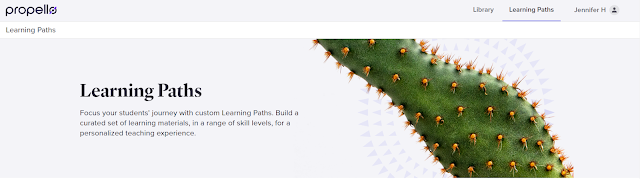
Within the curriculum, Learning Paths can be created for students based on teacher choice. It can be created for an entire district, a single class, a specific group of students, or an individual student. (Think about sub days, students who miss class for several days, students in ISS, or student groups based on readiness!) After teaching Physical Science at the high school level for over 10 years, I knew the concepts that needed to be reinforced at the middle school level. Propello is an excellent resource for customized, vertical alignment between grade levels. 

Personalized Learning with Propello

4. Personalization 

Propello has embedded supports that include translations to 100+ languages, read aloud, a visual dictionary, text isolation, and more. By using Propello, the lessons become “rewindable,” and students are able to spend the time they need on the content. Additionally, using the online content allows students to read and work at their own pace, freeing up time for a teacher to hold individual student conferences while everyone else is working.

Personalize learning with Propello

5. Save time

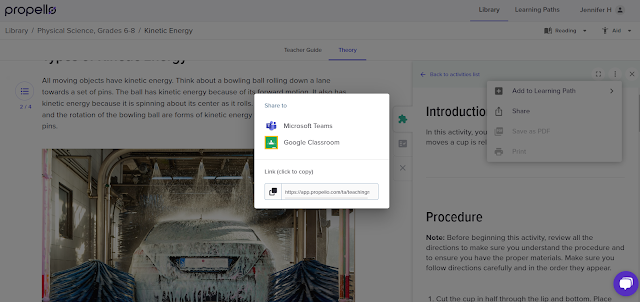
Teachers already have too much on their plates, and trying to comb through the vast number of online resources can be daunting and time consuming. Propello's teacher- and expert-created curriculum with built-in labs, activities, exercises, and teacher support saves so much time. Also, Propello easily integrates into Google Classroom and Microsoft Teams. Having Propello as a resource cuts down on preparation time, saving teachers loads of time spent at home and on the weekends getting ready for a lesson!

Personalize learning with Propello


https://propello.com/thecompellededucator

Differentiation and Extension

The four questions for Professional Learning Communities are 

1) What do we want students to know and be able to do?

2) How will we know if they learn it?

3) What will we do when they haven’t learned it?

4) How will we extend the learning when they already know it?

Many PLCs spend their time working through the first 3 questions and give little amount of attention to the 4th question. Propello assists teachers and PLCs in answering the critical fourth question. 

For many of the activities on the platform, Propello provides differentiation for students who need extra support as well as extensions for advanced learners.


Each unit also contains formative assessments throughout the reading assignments. This is helpful to the teacher to determine the level of readiness and comprehension of each student. 

| Sign up here and get started today |

Resources and Responsive Support

As I was navigating through Propello and wishing that this resource had been available when I was a classroom teacher, I found that I had a question that needed answering. It gave me the perfect opportunity to use the chat feature on the platform. 

Within an hour of asking my question about assigning Learning Paths to students and/or groups, I had a response from a team member. She also shared a link to another resource that she thought I may find helpful. The next day, I received a copy of the transcript from our chat via email!


Personalize learning with Propello

At Propello, you can find many teacher resources including articles and books about grading, standards, ChatGPT, science, and more. It truly is a space for student AND teacher learning!

Propello is in its early stages with plans to launch more subjects soon (English Language Arts in the fall of 2023). If you are or know a middle school science teacher, please share Propello with them! 


https://propello.com/thecompellededucator


Pin now, share later >>


Friday, April 14, 2023

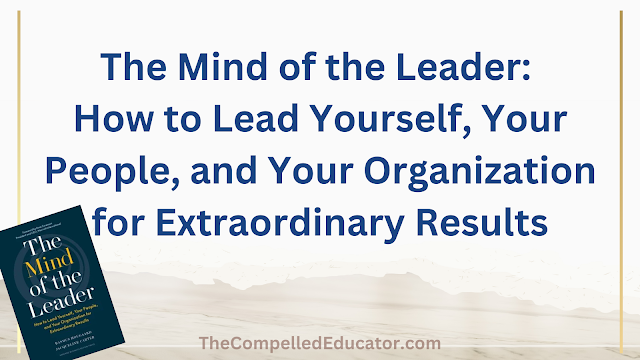
Cultivating a Mindful Culture: How Leaders Can Build Mindful Teams

The-Mind-of-a-Leader


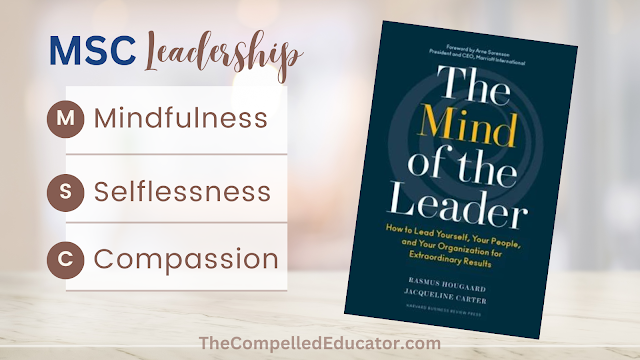
The Mind of the Leader by Hougaard and Carter is a must-read for anyone aspiring to become an effective leader. Throughout the book, the authors share ideas, practical tools, and strategies for improving leadership based on research including more than 35,000 leaders, and they distilled it into three main areas: mindfulness (M), selflessness (S), and compassion (C). 

Leadership

This post contains affiliate links. All opinions are my own. Thanks for supporting TheCompelledEducator.com

Called MSC leadership, it's leadership that begins with leading one’s self, then leading one’s followers, followed by leading one’s organization. 

Mindfulness, based on focus and awareness, allows leaders to be effective at giving their time and attention to goals, objectives, and pathways. 

Selflessness by the leader is the understanding that the leader is not the sole contributor to an organization’s success, and paired with self-confidence, the leader’s focus is that of the wellbeing of the organization and its employees. 

Compassion, not to be confused with empathy, creates a lens for the leader to view others and the organization with care, even in challenging and difficult situations. 

The three characteristics are interrelated and connected. Mindfulness (M) makes a person selfless, and selflessness (S) makes one more compassionate (C). To be an MSC leader, one must courageously commit to self-leadership and be willing to cultivate the three characteristics relentlessly.

Mindfulness is the pathway to self-awareness. Authors Hougaard and Carter go into detail about mindfulness and awareness, stating that mindfulness allows people to be fully in the moment and aware of thoughts, decisions, and actions while giving a pause where new thoughts, choices, and actions can be made.

Today’s world is full of distractions that lead people away from being mindful and self-aware. From email to social media to phone notifications, mindfulness can take a “back seat” to the incoming information and distractions. With the overwhelming amount of information that we face each day, it can lead to operating in autopilot mode. When on autopilot, leaders can say or do things without self-awareness of how the actions will be perceived from followers.


To become an exceptional leader, one needs to have consistent, focused performance. In The Mind of the Leader, the authors share four strategies to accomplish focused performance. 

  • In line with self-leadership, it is important for leaders to know what impacts their own focus, including time of day, caffeine, emotions, and physical health. 
  • The second strategy is to stop multitasking. Easier said than done, it is important to be aware when multitasking and limit one’s actions to one task at a time. While it may seem as though it is less productive to perform one task at a time, there are negative results that arise when multitasking. 
  • The third strategy for focused performance is to take time to do nothing. Our brains are wired to be doing something all the time, yet many of the behaviors in which we engage are non-productive tasks and distractions to our greater goal of focus performance. 
  • The fourth strategy is to create focus time. It is important to make it a priority to spend time away from devices and do focused work. As a leader, set aside time with your followers to work collaboratively on distraction-free activities.

Being kind to others is a side effect of showing compassion, and the authors remind us that it's important for leaders to show kindness to themselves as evidence of self-compassion. 

Showing kindness to oneself includes forgiving oneself for mistakes that happen. Leaders can feel like they have to have all the answers and do everything right, but the exceptional leaders understand that mistakes happen and they keep moving forward while silencing their inner critic. When leaders learn to be kind to themselves, they learn to be kinder to others, which in turn causes greater feelings of happiness and well-being. True happiness comes from what we do for others, not ourselves.

In the research by the authors, they found that one of the highest rating qualities of leadership was selflessness. Being a selfless leader is not being a servant to employees. It is about being of service to employees and helping them to grow in knowledge and skills. Becoming and being a selfless leader can be challenging because ego is hard to quiet without affirmations and getting credit. When the ego is left without recognition and praise, it often creates fear in a person. The fears can get in the way of being an effective leader, because it can  cause a leader to be indecisive, selfish, and bureaucratic. Once the fear is recognized and the ego in check, a leader can let go of the need for praise and affirmation. Some of the best leaders give credit to others on the team while taking the blame themselves, because they see failure as a means for success.

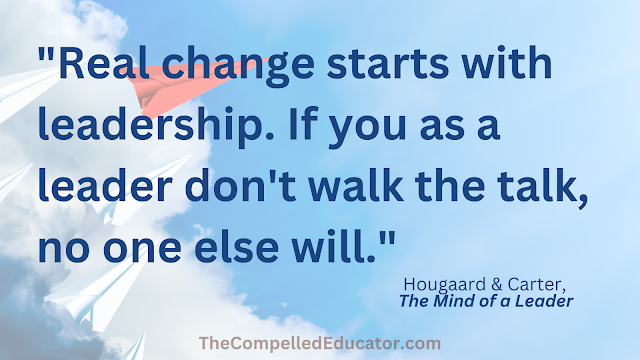
"Selfless leadership is about having the wisdom to develop and grow your people so they can shine and thrive with your support."        

                                                 - Hougaard & Carter, The Mind of the Leader

The Mind of the Leader by Hougaard and Carter is a must-read for anyone aspiring to become an effective leader. The authors provide insightful perspectives on leadership, including the importance of mindfulness, compassion, and self-awareness. They also offer practical tools and strategies to develop these qualities in oneself. Overall, this book is an excellent guide to cultivating the mindset and skills necessary for successful leadership.


Pin now, Share later >>


Wednesday, February 1, 2023

Resources, Tips, and 3 Ideas for Using ChatGPT as a School Leader

ChatGPT Tips

Technology is Always Evolving

We had a conversation in our doctoral class a couple of weeks ago about ChatGPT, and it got me to thinking about ways to use ChatGPT as a school leader. 

Technology is always evolving, and as I think back to when we started our one-to-one initiative at Hoover High School, we first made a turning point when our principal, Don Hulin, allowed our students to use their cell phones between classes, at lunch, and at other non-instructional times. This was at a time when most high schools were not allowing cell phones to be used at all during the school day. 

Teachers were encouraged to allow students to use their cell phones in creative ways - from recording a teacher's review session to watching rewindable, teacher-created lessons to fact-checking. We believed in and cultivated a culture of risk-taking and growth mindset

As the years passed and new technology was introduced, our teachers were open to trying new things that either 1) made their job easier (who doesn't want that!) or 2) created opportunities for deeper learning for our students. 

While I'm not typically first in line to try something new, I am genuinely curious about new technologies and try to find ways to implement them. However, I understand the mixed emotions and hesitancy of introducing a new technology school- or district-wide without thinking through scenarios and "what if" situations. 

As I think about ChatGPT, I also think about the time when calculators were introduced, and there was a debate about whether or not they should be allowed in classrooms. I think there are some similarities in the arguments against ChatGPT, and I will continue to research both sides as we all learn more about this new technology. 

Chatbots and AI are not new; in fact, many of us have used interacted with them on help websites for some credit unions, streaming services, and other businesses. However, they are new in the field of education as we currently know it.

"Since ChatGPT debuted in November, the nation's largest school districts have banned the artificial intelligence chatbot, concerned students will use the speedy text generator to cheat or plagiarize."

Even if schools ban ChatGPT, I do believe that school leaders can use it to improve workflow, and I want to share a few ideas here in this blog post. 
*Want to try ChatGPT? Use this link to go to the website, and click on Try ChatGPT. You can create an account, ask the chatbot a question, and it will give you a detailed answer in complete sentences. 

Ideas for Using ChatGPT as a School Leader


Below are a few ideas for busy school leaders on how to use ChatGPT to help lighten your load. When considering the suggestions below, it is important to remember that all communications should be in your voice. These ideas can help provide some shortcuts and "jumping off points" for busy school leaders. I DO NOT advocate using the Chatbot's answers as-is, but I do advocate for 1) not having to reinvent the wheel and 2) using the chatbot's outputs as a framework and as support for our own words. Think of ChatGPT as a virtual assistant who's writing your first draft!

1. Ask ChatGPT for help with written communication to parents

For example, I asked ChatGPT:
 
"Write an email to parents letting them know about the school open house event"

Here's what ChatGPT produced:

Subject: Invitation to the School Open House Event

Dear Parents,

I hope this email finds you well. I am writing to formally invite you to our upcoming School Open House event. This is a great opportunity for you to visit our school, meet the teachers, and get to know more about our programs and facilities.

The Open House event will take place on [date and time]. During this time, you will have the chance to tour the school, speak with our teachers and staff, and learn about our curriculum and extra-curricular activities. You will also have the opportunity to ask questions and get to know our school community better.

We believe that a strong partnership between home and school is essential for student success, and we believe that this event will be a great opportunity for you to get involved and learn more about our school.

If you have any questions, please do not hesitate to reach out to us. We look forward to seeing you on the day of the event!

Best regards,

[Your Name]
[School Name]

2. Ask ChatGPT for help with written communication to community partners

This is what I asked ChatGPT:

"Write a thank you note from a principal to a community partner"

This is what ChatGPT produced:

Dear [Community Partner],

I am writing to express my deepest gratitude for your support and partnership with our school. Your contributions have made a tremendous impact on the lives of our students and have helped to strengthen our community as a whole.

The generosity and dedication you have shown towards our school and its programs are truly inspiring. Your efforts have provided our students with opportunities and experiences that they will never forget, and have helped to create a brighter future for all of us.

Please accept my heartfelt thanks for all that you have done. Your kindness and support mean the world to us, and we are so grateful to have you as a partner.

With warm regards,

[Principal's Name]

3. Ask ChatGPT to help with speech writing

This is what I asked ChatGPT:

"Write a welcome speech by a principal to honor society induction"

This is what ChatGPT produced:

Good evening everyone, and welcome to the induction ceremony of our school's Honor Society. It is my pleasure to stand before you today and celebrate the achievements of our students.

I would like to start by congratulating all of the new inductees for their hard work and dedication. Your commitment to academics, leadership, and service has earned you a place among the best and brightest students in our school. You should be proud of your accomplishments and the example you set for others.

I would also like to extend a special thank you to the teachers, staff, and families who have supported and encouraged these students along the way. Your dedication and support have been instrumental in their success.

As members of the Honor Society, our new inductees have joined a long and distinguished tradition of excellence. They will have opportunities to participate in service projects, leadership initiatives, and academic events that will further their growth and development. I encourage each of them to take advantage of these opportunities and to use their talents and abilities to make a positive impact in our school and beyond.

So once again, congratulations to our new inductees, and thank you all for joining us tonight. I am confident that each of you will continue to make us proud and continue the legacy of excellence that is the Honor Society.

With that, I would like to officially welcome you to the Honor Society and wish you all the best in your future endeavors.

Thank you.


ChatGPT Tips


Here are some words that will help with your chat prompts/requests, and as a reminder, the better questions we ask of it, the better our results will be. Test and iterate!

“Generate”
“Create a bullet list of”
“Write XX words”
“Make a table of”
add “explain like I’m 5” for complex answers

Want to learn more about ChatGPT? 


What is your reaction to using ChatGPT with students?

How else can ChatGPT be used by school leaders?

I would love to hear your thoughts about using ChatGPT in your personal life or in your professional role! Please reach out to me on twitter or leave a comment below!


Pin now, Share later >>


Jennifer-Hogan